The roof system you’re investing in
You don’t need to know roofing to buy a good roof. It helps to know what each layer does, so you can tell when a bid leaves one out. Here’s the whole roof, from the wood up, in plain terms, along with the words you’ll see in your proposal.
How a roof keeps water out
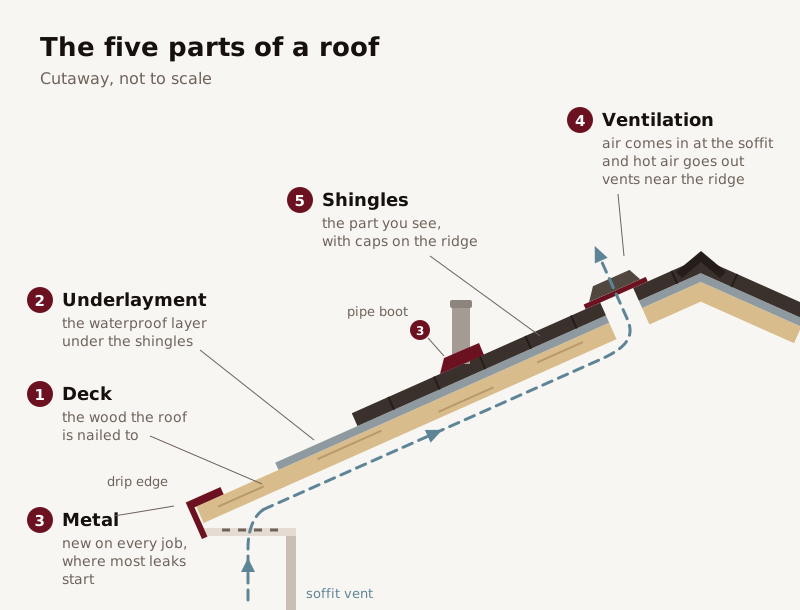
Most people think of a roof as shingles. Shingles are only the top layer. They shed most of the rain when it falls straight down. The other four parts handle everything else: rain the wind pushes sideways, water running down a wall or around a chimney, and the heat and moisture that rise into the attic from inside the house.
Those four are the ones you can’t see from the street, so they’re easy to leave out of a bid. Every one of them is in our base bid.
The deck
The wood your roof is built on, and the one part nobody can fully see until the old roof comes off.
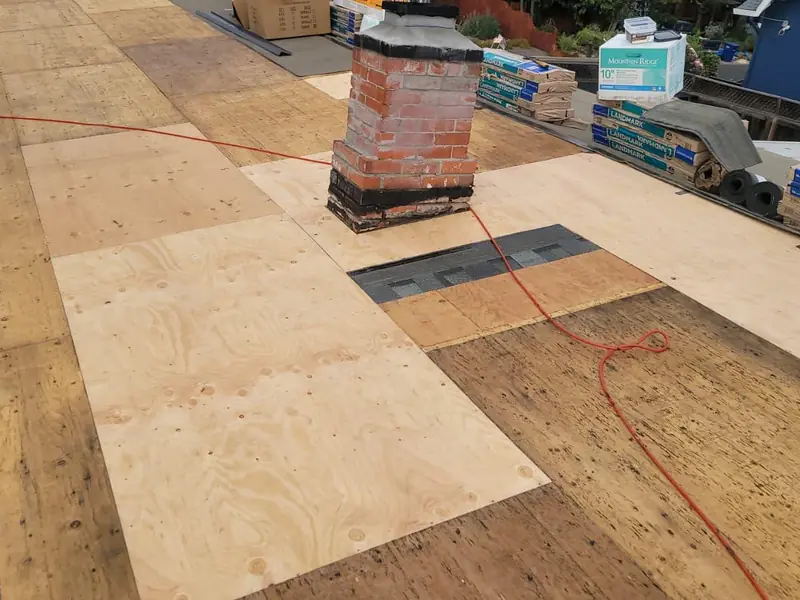
What it is. Sheets of plywood nailed across the rafters (the sloped beams that form the shape of your roof). Older homes sometimes have long boards with gaps between them instead of solid sheets.
What it does. It holds the nails. Years of small leaks can turn wood soft, and that’s what roofers call dry rot. Soft wood can’t grip a nail, and a shingle that isn’t held down will lift in the first strong wind.
What happens if you find dry rot?
It’s a fair question, since it’s the one part of the job nobody can price from the ground. Once the old roof is off, we photograph what we find and show you. We replace only the wood that has to be replaced, and bill it at $75 per person per hour, with lumber at cost. Nothing goes past $3,500 without another signature from you.
Underlayment
A second waterproof layer under the shingles, for the rain that gets past them.
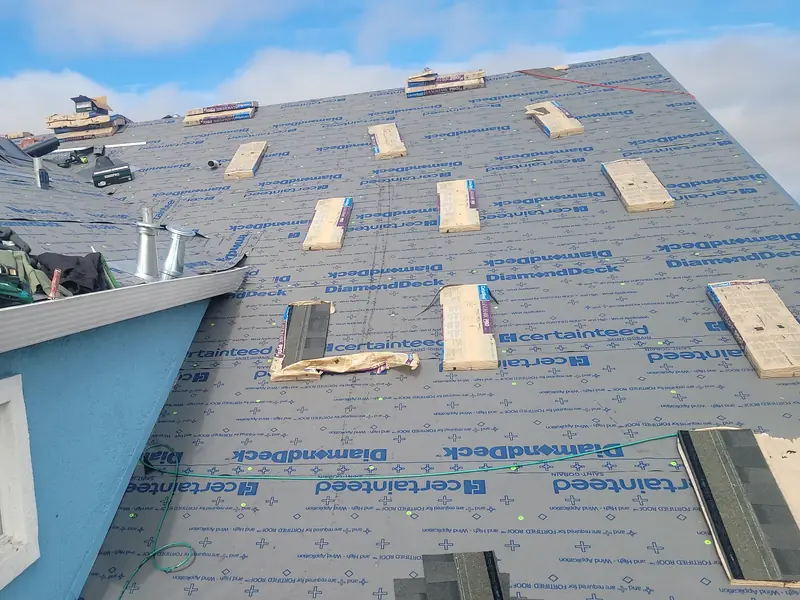
What it is. A sheet rolled out over the whole deck before any shingles go on. Our standard is ABC ProGuard (manufactured by Owens Corning).
What it does. Shingles overlap like scales, which works when rain falls straight down. Wind pushes rain sideways and up under the edges. The underlayment catches that water before it reaches the wood.
Why the steepness of your roof matters
Roofers call steepness pitch (or slope), and write it as inches of rise for every 12 inches across. A 4/12 roof climbs 4 inches over each foot. The flatter the roof, the slower water drains, and the more likely it is to back up under the shingles. So we choose the underlayment for your pitch.
Nearly flat — 2/12 and 3/12
Water sits longer here. The whole deck gets peel-and-stick underlayment, which sticks to the wood like tape and seals around every nail.
Most homes — 4/12 and steeper
Water runs off quickly, so a tough synthetic sheet does the job: ABC ProGuard, CertainTeed DiamondDeck or Owens Corning ProArmor. It won’t tear when the crew walks on it or wrinkle in the heat.
Upgrade — high-heat peel-and-stick
Owens Corning Titanium PSU30, a heavier peel-and-stick built for extreme attic heat.
The valleys get extra care
A valley is the crease where two slopes of the roof meet. Water from both sides funnels into it, so it carries more than anywhere else on the roof. We cut the shingles there California style: shingles from one side run through the crease, and the other side is trimmed in a straight line over them, so there’s no seam for water to find. Wherever your city’s code requires it, we add ice and water shield, an extra self-sticking waterproof layer, underneath.
Metal
Most leaks start at the edges of a roof, or wherever something pokes through it. Metal is what seals those spots.
What it is. Shingles lie flat, so they can’t seal a corner, a wall or a pipe. Roofers bend sheet metal to fit each of those spots and call it flashing. You’ll see these pieces named in your proposal:
- Drip edge — the metal strip along every edge of the roof. It steers water into the gutter instead of letting it curl back under onto the wood.
- Step flashing — small L-shaped pieces woven in with the shingles where the roof meets a wall, so water running down the siding lands on top of the roof instead of behind it.
- Cricket, or saddle — a small peaked ridge of metal built on the uphill side of a chimney or skylight. Water splits around it instead of pooling against the back. For wide chimneys and skylights we install a saddle custom-made by a local sheet metal shop.
- Pipe boots — the collars that seal around the plumbing vent pipes sticking up through your roof.
Every piece is new and painted to match your roof.
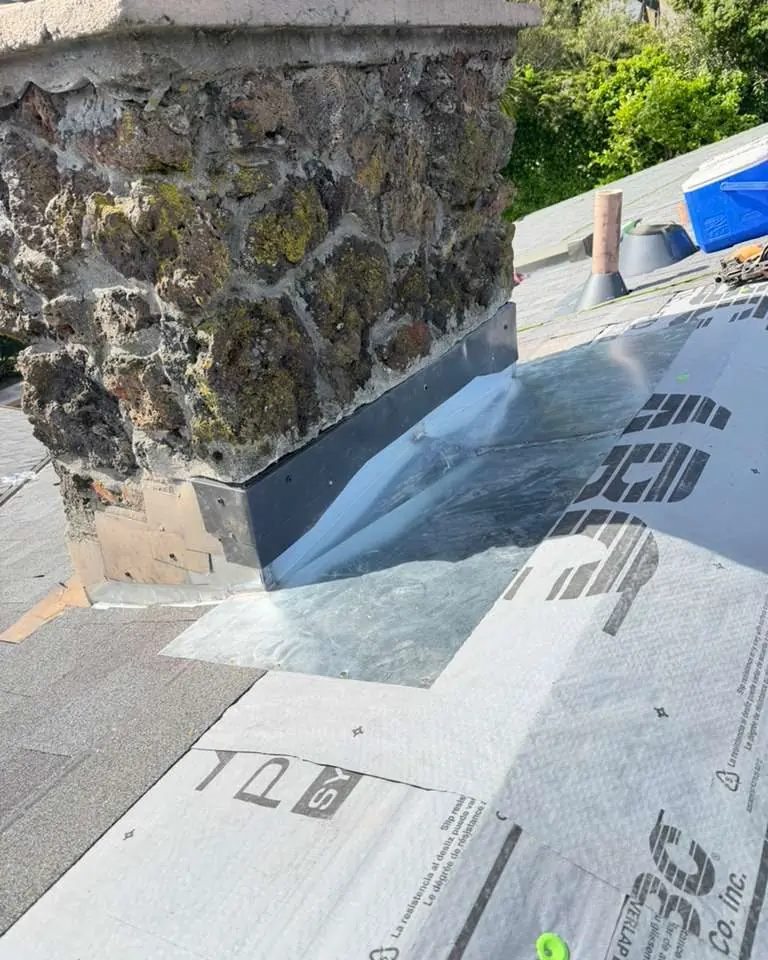
Does the metal on my roof need to be replaced too?
It’s a fair question, since metal often looks fine from the ground. The trouble is how an old roof comes off. Prying up shingles bends the metal out of shape, and the nail holes from the first install stay open.
- Edge metal — once it’s bent during tear-off, it no longer sits tight against the roof, and wind-blown rain gets in behind it along the sloped edges at the sides of the house.
- Wall flashing — the old pieces are full of nail holes from the first roof. Put back, every hole is a path for water running down your wall into the framing.
- Pipe boots and chimney metal — the rubber in pipe boots breaks down in the sun within 10 to 12 years, and chimney metal cracks from heating up and cooling down. Both usually give out before the shingles would.
Manufacturers won’t extend their best warranties over reused metal. A 30-year shingle can’t outlast metal that’s already halfway through its life.
Ventilation
Your attic has to breathe. If it can’t, the roof wears out from underneath.
Why it matters. Heat and moisture rise into the attic every day, from the sun on the roof and from showers, cooking and laundry in the house. If that air can’t get out, it heats the shingles from below and dampens the wood from inside.
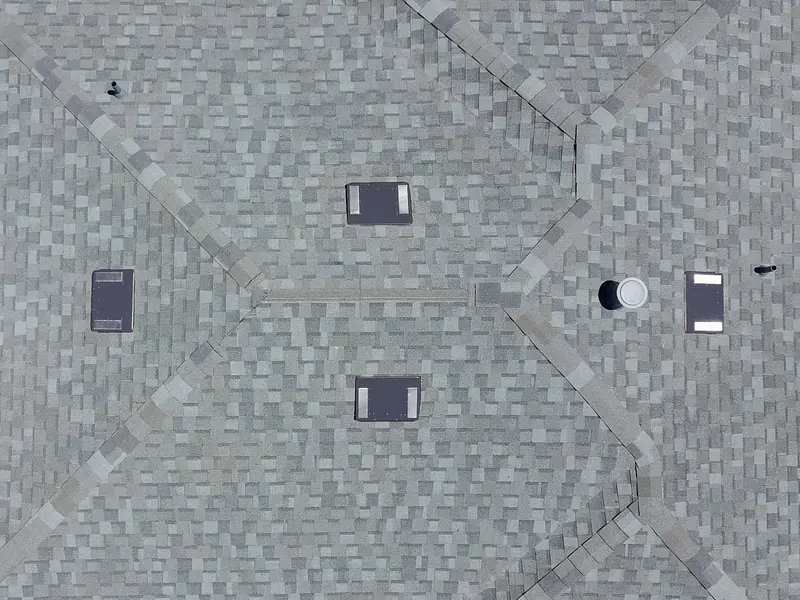
What it is. Air comes in low, through vents under the overhang of the roof (roofers call these soffit vents), and goes out high, through exhaust vents near the top. Every base bid includes low-profile O’Hagin exhaust vents, about one for every 300 square feet, and we check that enough air is coming in to balance them. A ridge vent, one long vent along the peak, is available as an upgrade.
Does my attic ventilation really matter that much?
- Wet wood — warm, damp air from inside settles on the cold underside of the plywood, the same way a cold glass sweats. Over the years, that turns into dry rot.
- Baked shingles — an attic with no airflow can pass 150°F. That heats the shingles from underneath, so they curl, blister and shed the granules that protect them.
- Sagging wood and mold — plywood that stays damp starts to come apart in layers and sag, and mold follows.
Shingle manufacturers require balanced airflow in and out before they’ll honor their extended warranties, because they know what a hot, damp attic does to their product.
Shingles
The top layer, and the part you get to choose. Shingles shed most of the rain, and they’re what everyone sees from the street.
We are an Owens Corning Preferred Contractor and a CertainTeed Master Craftsman, so your base bid includes Owens Corning Duration or CertainTeed Landmark, the two shingles we install most. Three step-ups are available if you want a thicker shingle or a different look. Once you pick a line, color never changes the price.
Compare every shingle line in depth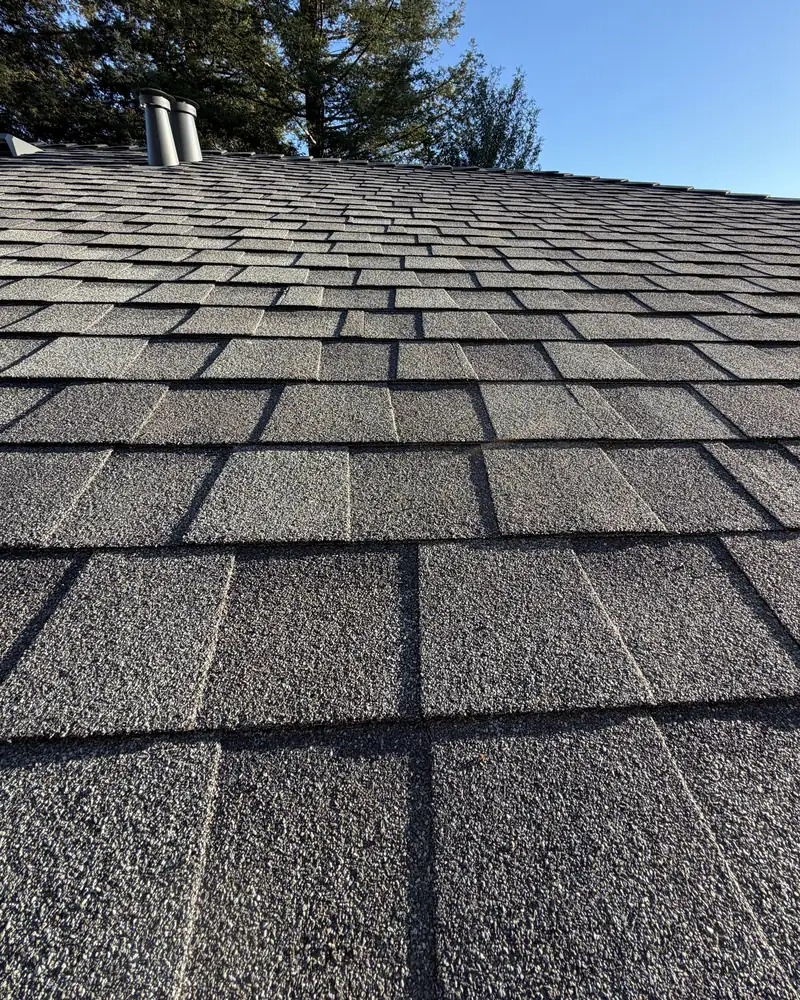
Duration · Landmark
A dimensional shingle, made in two layers so it has depth instead of looking flat. It’s on most of the roofs we install.
Duration MAX · Landmark PRO
Thicker, with more layers bonded together. It has deeper color and more shadow, so the roof looks more textured from the street.
Woodcrest · Presidential
Looks like a wood shake roof, with the highest fire rating a roof can get (Class A) and none of the upkeep of real wood.
Woodmoor · Presidential TL
Our thickest wood-shake look, with the most depth and shadow.
Cool Roof, in every line
A cool roof shingle reflects more of the sun instead of soaking it up. It’s available in every line from both manufacturers.
- California’s energy code — helps the home meet Title 24, the state’s building energy standards.
- A cooler house — a cooler attic can lower temperatures inside by 1 to 2 degrees on the hottest days.
- A cooler street — when several homes on a block have them, the whole street holds less heat.
Flat roofs
Flat sections don’t shed water the way sloped ones do, so they get a different build. First an FR10 slip sheet, a fire-resistant layer that gives the roof its Class A fire rating. Then a half-inch insulation board, for a smooth base and a cooler house. On top goes TPO, a single white membrane with its seams heat-welded together.
- Thicker insulation — 1" or 2" board in place of the standard half inch.
- Tapered boards — insulation cut on a slight slope, so water drains instead of sitting in puddles.
Roofing terms, in plain English
Every roofing proposal uses these words, ours included. If a part of the roof isn’t mentioned in a bid, ask the roofer about it.
- Square
- 100 square feet of roof. Roofs are measured and priced by the square.
- Pitch
- How steep the roof is, written as rise over 12 inches, like 6/12.
- Tear-off
- Removing the old roof down to the wood before the new one goes on.
- Deck
- The plywood or boards the roof is nailed to. Also called sheathing.
- Dry rot
- Wood gone soft from years of moisture. It can’t hold a nail.
- Underlayment
- The waterproof sheet between the wood and the shingles.
- Flashing
- Bent metal that seals the roof at walls, chimneys, pipes and edges.
- Drip edge
- The metal strip along the roof’s edges that sends water into the gutter.
- Valley
- The crease where two slopes meet and water funnels together.
- Cricket
- A small metal ridge behind a chimney that splits water around it.
- Ridge
- The peak, where two slopes meet at the top.
- Eaves
- The lower edges of the roof, where the gutters hang.
- Rakes
- The sloped edges at the sides of a gable.
- Soffit vents
- Vents under the roof’s overhang that let fresh air into the attic.
“The attention to detail was ongoing throughout the project. They refurbished the skylights and house vents and then painted them a color that matched the shingles.”
 Read on Yelp
Questions about the roof system
What are underlayment, flashing and ventilation, and why do they matter?
Underlayment is the waterproof layer under the shingles: synthetic on standard and steep roofs, 100% peel-and-stick on low slopes. Flashing is the metal at every wall, chimney, skylight and pipe, and leaks almost always start there, so we never reuse it. Ventilation moves air through the attic; without it an attic can pass 150 degrees in summer. We install O’Hagin exhaust vents balanced with your intake vents.
Can you replace a flat or low-slope roof too?
Yes, with our own crew. Shingles can’t go on anything flatter than 2/12. Flat sections get an FR10 slip sheet for a Class A fire rating, half-inch insulation board and a TPO membrane, welded at every seam and edge. If the roof ponds, put the money into tapered insulation first.
Which shingle brands do you install?
Owens Corning and CertainTeed. We’re an Owens Corning Preferred Contractor and a CertainTeed Master Craftsman. Most of the roofs we do get Owens Corning Duration or CertainTeed Landmark, and we price them the same.
Where your old roof goes
Tear-off goes to certified green transfer stations and is processed into recycled asphalt for local roads. A typical tear-off of 2.5 to 3.5 tons helps pave about 200 feet of two-lane road. Every permit and weight ticket is tracked.